Crédit photo : UNESCO Le Havre
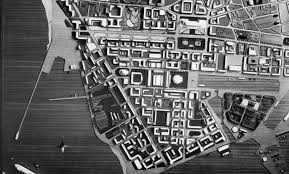
After WWII, the French Ministry of Reconstruction and Urban Planning (MRU) appointed the architect Auguste PERRET’s studio to entirely restore Le Havre’s historic centre. Le Havre’s post-war reconstruction is definitively an example of modern architecture. Indeed, the architect developed technological innovations and chose reinforced concrete, a new construction material, to make all new dwellings, inasmuch as it was a versatile material which was able to bring numerous advantages in the context of post-war reconstruction. This “artificial stone” even became Le Havre’s signature look, from Buildings Without Individual Allocation (ISAI) to avant-gardist monuments such as the Town Hall or the Saint-Joseph’s Chuch.[1]
Through his unique work, the architect Auguste PERRET was defined as a “moderate modern”.[2]On the one hand, Auguste PERRET remained a classicist architect by following the principles from the “Structural Classicism School”, which referred to the French traditional style from the 18thand 19thcenturies with architectural forms such as columns, pilasters or spans.[3]On the other hand, he was a modernist architect by using innovative materials, in particular reinforced concrete, and by not hiding the building technique through ornaments. He was even known as the reinforced concrete’s master of that time. According to his doctrine, the “building-truth” even had to highlight it: “give it the splendour of truth and a building becomes beautiful”.[4]In fact, modern architecture was considered as a mean to improve the living conditions in France, by favouring air and sun for hygiene and safety reasons. This meant that it would reject the “out-dated plots” and “quarters without lungs” from the past, that is to say the narrow and irregular streets as well as the close and insalubrious dwellings with a high density of population.[5]Auguste PERRET’s doctrine and these architecture principles were part of Le Havre’s signature look during its post-war reconstruction.
Indeed, the architect took the side of reconstructing the Buildings Without Individual Allocation (ISAI) in reinforced concrete, as it was also a versatile material which would introduce a new way of life by providing all modern comfort during the “Glorious Thirty”. On the one hand, the concrete’s low ductibility made it a soft material which could reduce the building’s weight and so open its façades with large and vertical windows. By creating different heights and terraced roofs, Auguste PERRET could even control that each dwelling would receive a sufficient amount of natural light during the daytime without creating shadows for others. On the other hand, the steel frameworks’ high ductility upgraded concrete as a thick material which gave a good insulation. Thanks to its thermal mass which maximised the energy storage, it protected the rooms from cold and heat and so minimised heating and air-conditioning. More than an energy efficiency, it also enabled a sound attenuation. Besides, reinforced concrete allowed to concentrate all the building’s weight on thick beams and posts inside the façades. The absence of bearing walls and the sliding partitions meant that each flat had a modular interior which gave flexibility and personalisation to French families in terms of design. However, the initial layout was already optimised for functionality as long stay rooms – kitchen, dining-room, lounge, bedrooms – were positioned on the sides of each flat to profit from the light and the view. Although bathrooms and waters used to be situated next to the windows for ventilation, they were now located at the centre and connected to all rooms. Ventilation operated thanks to “Swiss ducts” which allowed the air to circulate into two ducts.[6]Technical innovations such as central heating were also rationally thought to increase the quality and reduce the costs of Le Havre’s post-war reconstruction.
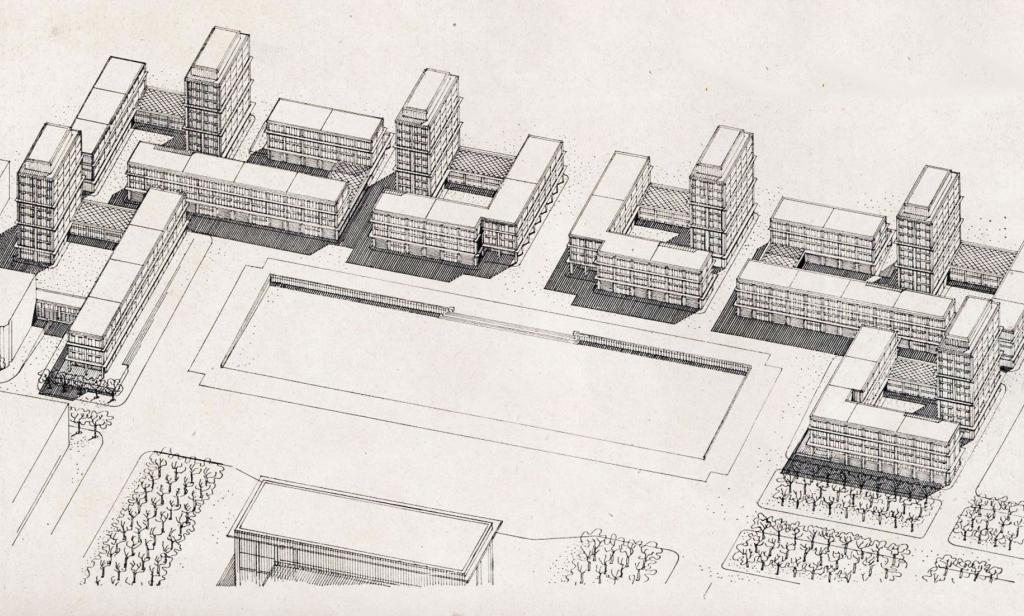
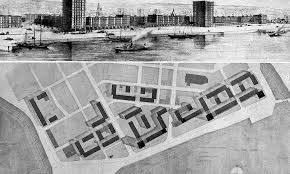
Technically, reinforced concrete gave the opportunity to reconstruct cheaply, quickly and vastly in the context of massive destructions thanks to its physical qualities, but also thanks to the building processes that it generated. The industrialisation of the building industry after WWII enabled to favour architectural experimentation and to benefit from a low-cost and mass production of this material. Reinforced concrete was a quick-to-make and easy-to-use material which needed low-skilled labour. Instead of a wood casing in which concrete was poured, a metallic one was preferred as it could be reusable to save both money and time. With the same purpose, prefabrication techniques were also developed for smaller elements such as doors, window frames or concrete-gravel panels. Moreover, buildings were standardised on the square module of 6.24 meters size, which was the optimal depth of a reinforced concrete beam, in order to limit the length and so the cost of façades. This perfect number was also divisible by two and three and provided a sufficient space for living areas. According to PERRET’s doctrine, this standardisation of buildings brought both “harmony and uniformity” which were “preferable to disorder”.[7]Thanks to a plot consolidation which ended the shared land ownership, a “modern townscape of wide streets and apartment blocks” and towers was created on a checkerboard and orthogonal grid inspired from American cities.[8]The ISAI were cubic blocks, that is to say interior courtyards delimitated by five-floor buildings with bordering balconies and opened from the street to house the access to underground car parks. Auguste PERRET also implemented a “regionalist architecture” as it was adapted to the climatic conditions of Le Havre’s local area.[9]This could be expressed through lateral galleries to protect from the rain, resistant materials on the façades from windstorms or even a grainy-textured concrete at the border of the sea from the sand brought with the wind.
Aesthetically, reinforced concrete was also a flexible material which could be moulded in all possible forms and motives: “concrete is the stone that we make, much more beautiful and more noble than the natural one”.[10]This “artificial stone” favoured architectural experimentation as it could produce avant-gardist monuments such as the Town Hall or the Saint-Joseph’s Church, which were the two first monuments seen on Le Havre’s skyline. Although they were built on their pre-war sites, they did not correspond to the traditional models of political and religious buildings in France. Indeed, the Town Hall’s square belfry of 72 meters high brought into opposition its horizontal body, where large bay windows as well as a classic colonnade are re-invested in a modern way with fluted columns and palmiform capitals. Only reinforced concrete remained the common thread between the two parts of the building. Furthermore, the Saint-Joseph’s Church’s lantern-tower of 107 meters high, which was described as a “lighthouse of celestial inspiration”, was based on four massive pillars in reinforced concrete and openwork with geometric stained-glass windows realized by the artist Marguerite HURE.[11]The claustras looked transparent from outside but coloured from inside in distinct hues at each cardinal point. This created a play-on-light which conveyed a different atmosphere to the church’s interior when the sun moved from east to west throughout the daytime. More than forms, reinforced concrete also appeared as a diverse material in both monuments in terms of buildings’ colours – antique pink, cream beige, light grey – as well as details’ textures – granular, bush-hammered, smooth concrete. That is why despite numerous criticisms of homogenization and monotony, Le Havre’s post-war reconstruction proved that both diversity and originality could come from the use of a cold, grey and unique material.
As a conclusion, Le Havre’s post-war reconstruction is an example of modern architecture through the use of reinforced concrete, a new construction material, as well as technological innovations.
[1]« Pierre artificielle », PERRET Auguste, “Propos sur la reconstruction”, (1st of April, 1946), Le Décor d’aujourd’hui, n°35 (1/3), page 6
[2]« Moderne modéré », ARNOULT Paul, JACONO Guillaume, “Le Havre, paysage urbain et patrimoine entre béton, discours et images. De la reconstruction physique à la (re)construction mentale (1945-1995)”, Cahiers de la Méditerranée(2000), Volume 60 (1), page 110
[3]Ecole du Classicisme Structurel
[4]« Edifice-vérité », « C’est par la splendeur du vrai que l’édifice atteint la beauté », PERRET Auguste, “Propos sur la reconstruction”, (1st of April, 1946), Le Décor d’aujourd’hui, n°35 (1/3), page 6
[5]« Tracés périmés », « Quartiers sans poumons », CREMNITZER Jean-Bernard, “La reconstruction du Havre et de son habitat”, Unité Libre 2017-2018 Construire-reconstruire-déconstruire une ville, Université Le Havre Normandie (Conference on Wednesday, February 15th, 2017)
[6]« Gaines suisses »
[7]« Harmonie et uniformité », « L’uniformité est préférable au désordre », PERRET Auguste, “Propos sur la reconstruction”, (1stof April, 1946), Le Décor d’aujourd’hui, n°35 (1/3), page 6
[8]CLOUT Hugh, “The reconstruction of Upper Normandy: a tale of two cities”, Planning perspectives(1999), Volume 14 (2), page 184
[9]« Architecture climatique, régionaliste », CREMNITZER Jean-Bernard, “La reconstruction du Havre et de son habitat”, Unité Libre 2017-2018 Construire-reconstruire-déconstruire une ville, Université Le Havre Normandie (Conference on Wednesday, February 15th, 2017)
[10]« Le béton, c’est la pierre que nous fabriquons, bien plus belle et plus noble que la pierre naturelle », PERRET Auguste, “Propos sur la reconstruction”, (1st of April, 1946), Le Décor d’aujourd’hui, n°35 (1/3), page 6
[11]« Phare d’inspiration céleste », PERRET Auguste, “Propos sur la reconstruction”, (1st of April, 1946), Le Décor d’aujourd’hui, n°35 (1/3), page 6

 Le Cycle 2019